
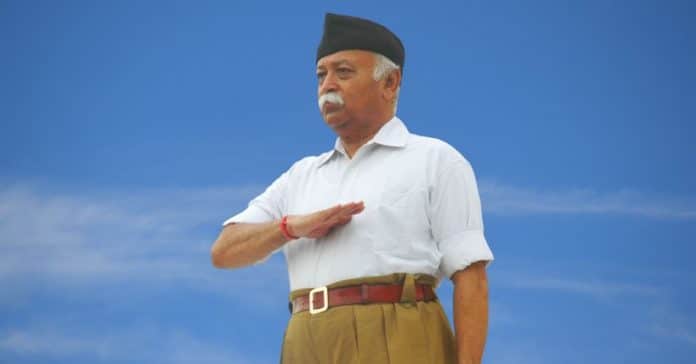
NEW DELHI — RSS chief Mohan Bhagwat has said Hindutva does not envisage an India without Muslims, asserting that a person who believes that followers of Islam have no place in the country cannot call himself a Hindu.
Speaking at a faith leaders’ conference in New York on Saturday, Bhagwat said the idea of a Hindu Rashtra should not be interpreted as one that seeks to drive Muslims out of the country.
Responding to questions he said Muslims had raised during his interactions with them about the RSS’ vision of a “Hindu Rashtra,” Bhagwat said there was no question of excluding them from the country.
“If any Hindu thinks that there should be no Muslims in Bharat, he will not remain Hindu,” he said.
The RSS chief stressed that people may practise different religions but share a common humanity, and said India’s civilisational tradition has been to provide shelter to people regardless of their religious identity.
Bhagwat also spoke about the organisation’s service activities, saying around 1.3 lakh projects are currently being run by RSS volunteers with support from society.
Citing an incident in Dadri, Haryana, involving a collision between two aircraft from Muslim-majority countries, he said RSS volunteers were among those who reached the site and helped with arrangements after all passengers were killed. He said the volunteers did not approach the victims differently on the basis of their religion.
“We don’t have the thought that they are Muslims,” Bhagwat said, describing the approach adopted by RSS volunteers during relief and service activities.
The RSS chief said the organisation’s broader philosophy was to move beyond individual interests and work towards collective welfare.
“Where there is ‘me’ and ‘mine’, there is no solution. ‘We’ and ‘ours’ is the solution,” he said.
Bhagwat said the RSS had expanded its engagement with members of minority communities, particularly Muslims and Christians, since 2018, describing dialogue and service as important means of building understanding.
Referring to Ramakrishna Paramahamsa, he said the spiritual leader had explored different religious traditions, including Islam and Christianity, and cited his teaching that different paths could lead to the same destination.
Bhagwat further said the principle of human unity was reflected both in India’s traditional thought and its Constitution.
He argued that lasting social transformation could not be achieved through political action alone and called for community-level efforts based on dialogue, selfless service and social unity.
“Things cannot be achieved through politics alone,” he said, adding that politics had increasingly become driven by self-interest and that social change needed to begin within society.
Follow Us
The Kashmir Pulse is now on Google News. Subscribe our Telegram channel and Follow our WhatsApp channel for timely news updates!