
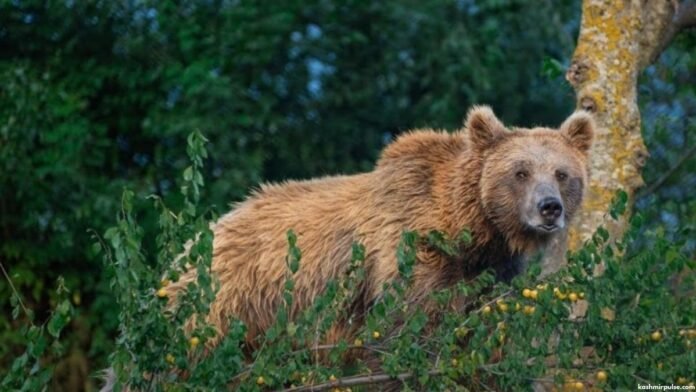
SRINAGAR — A three-month camera-trapping study by Wildlife SOS in collaboration with the Jammu & Kashmir Wildlife Protection Department has generated new insights into the behaviour, habitat use and hibernation patterns of Himalayan brown bears across the Kashmir region.
During the winter months of 2025, Wildlife SOS deployed 17 camera traps at identified Himalayan brown bear dens at elevations exceeding 4,000 metres across the Sonamarg landscape. The cameras remained in place for three months and captured footage of activity at the remote den sites.
According to Wildlife SOS, the observations will help researchers assess and understand brown bear behaviour during the winter period without repeatedly approaching the animals at their high-altitude dens.
The initiative builds on India’s first radio-collaring and telemetry-based research project on Himalayan brown bears, launched by Wildlife SOS and the Jammu & Kashmir Wildlife Protection Department in 2023. Six bears were fitted with GPS-enabled radio collars to study their movements, habitat use and seasonal behaviour.
During the earlier study, researchers identified locations used by the bears for denning and resting. Wildlife SOS and the Wildlife Protection Department are planning a second phase of research focused specifically on denning behaviour, with camera traps to be deployed at the identified sites to examine denning behaviour and the habitat characteristics selected by the bears.
“By combining GPS telemetry with camera trapping, we hope to better understand their denning behaviour and the habitats they depend on,” said Kartick Satyanarayan, Co-founder and CEO of Wildlife SOS. “These insights can help strengthen conservation planning for the species.”
Preliminary findings from the radio-collaring study showed that Himalayan brown bears in the Sonamarg landscape frequently use garbage dumps and areas near human habitation for foraging.
Wildlife SOS said a 2021 study found that nearly 75% of the diet of brown bears frequenting garbage dumps consisted of plastic, chocolates and other food waste, highlighting the impact of improper waste management on their natural foraging behaviour.
Alongside radio telemetry and camera trapping, occupancy surveys are also being conducted to map bear distribution and habitat use across the landscape.
Geeta Seshamani, Co-founder and Secretary of Wildlife SOS, said understanding the changing landscapes used by Himalayan brown bears was important for identifying pressures affecting the animals and strengthening long-term conservation efforts.

“Himalayan brown bears are an irreplaceable part of Kashmir’s natural heritage, and protecting them requires us to understand the changing landscapes they navigate,” Seshamani said.
Aaliya Mir, Education Officer and Programme Head–J&K at Wildlife SOS, said understanding what brings bears closer to human settlements could help in developing measures to reduce conflict.
She also stressed the role of local communities and young people in building awareness and promoting coexistence between people and bears.
The study comes amid human-bear interactions in areas where natural food resources overlap with human activity and tourism. Wildlife SOS said understanding seasonal bear movements could help identify important habitats and movement corridors and support the management of human-wildlife interactions.
The GPS-collar data will continue to be analysed to document bear movements before, during and after the denning period. Wildlife SOS said the combined findings from camera trapping, radio telemetry and occupancy surveys would contribute to a better understanding of Himalayan brown bear ecology in the Kashmir landscape and help inform conservation and conflict-mitigation strategies.
Follow Us
The Kashmir Pulse is now on Google News. Subscribe our Telegram channel and Follow our WhatsApp channel for timely news updates!