
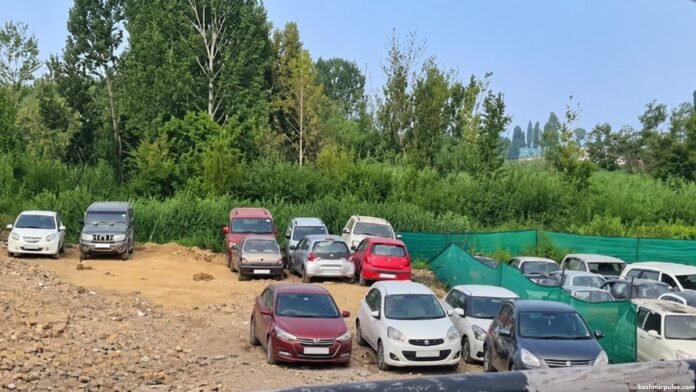
SRINAGAR — Landfilling along a portion of the Brari Nambal waterbody in the heart of Srinagar, now being used for parking vehicles, has raised questions over the protection of the lagoon and monitoring of its vulnerable areas.
Photographs from the site show a sizeable stretch described as a filled portion of the waterbody, with several cars parked on the reclaimed area.
The location is close to the office of the J&K Lake Conservation and Management Authority (LCMA), prompting questions over how the activity took place and whether it was detected while the filling was under way.
A key issue before the authorities is whether the filled material will be removed and the affected portion restored.
Questions have also been raised over who carried out the landfilling and whether any permission was obtained. Residents and observers said that, if the activity was unauthorised, those responsible should be identified and action initiated under the applicable law.
Jammu Kashmir Apni Party president Syed Muhammad Altaf Bukhari has also questioned the reported landfilling and alleged encroachment at Brari Nambal, asking how such activity could continue for nearly two weeks and which department was responsible for monitoring the site.
The issue comes as the LCMA is undertaking restoration-related work at Brari Nambal. During an inspection in July, the Authority’s Vice Chairman reviewed conservation and restoration works and stressed regular monitoring and long-term protection of the waterbody.
Earlier in August, LCMA officials again inspected Brari Nambal and reviewed shoreline cleaning and other restoration measures. They directed officials to remove weeds, solid waste and debris and expedite conservation work.
The latest allegations have therefore raised questions not only about the reported fresh filling but also about the effectiveness of monitoring around a waterbody already undergoing restoration.
A retired government official familiar with Srinagar’s waterbodies said restoration efforts would have limited value if fresh filling and alteration of the waterbody were allowed to continue.

“The first responsibility should be to prevent new damage. If filling has taken place, the administration should establish who did it, whether any permission was obtained and what action followed,” he said.
Environmental observers said the affected portion should be surveyed and its status established through official records and on-ground measurements before any further activity is permitted.
Brari Nambal has a long history of encroachment and degradation. The National Green Tribunal has previously registered proceedings concerning pollution and encroachments at the waterbody and sought information from authorities on the extent of encroachment, establishments occupying lake land and the future conservation plan.
The latest concerns have also revived a broader debate over the role of environmental watchdogs and civil society organisations in monitoring vulnerable water bodies across Kashmir.
Sources familiar with environmental issues in the Valley said such groups often raise concerns after an alleged violation comes into public focus, but argued that more sustained field-level monitoring, documentation and follow-up were needed before and after cases attract wider public attention.
A retired government teacher following environmental issues in Kashmir said environmental protection should not depend solely on statements issued after an incident or alleged violation becomes a matter of public debate.
“Those claiming to act as watchdogs should regularly visit vulnerable water bodies, document changes, identify fresh encroachments and pursue the matter with the concerned authorities,” he said.
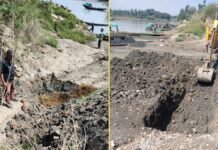
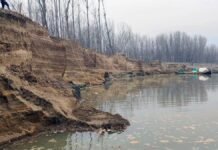
The concerns come against a wider backdrop of allegations of encroachments, illegal sand mining and degradation affecting water bodies across Kashmir.
A recent academic study by researchers associated with the Central University of Kashmir described illegal sand mining in the Jhelum as a major environmental-law and governance challenge, citing concerns including riverbank erosion, habitat destruction and increased flood vulnerability.
The National Green Tribunal has also dealt with alleged illegal sand extraction and damage to the Jhelum embankment near Khankah Bagh in Pampore after taking suo motu cognisance of a report concerning the alleged destruction of the embankment and risks to nearby households.

In August, an environmentalist submitted a memorandum to the J&K Legislative Assembly’s Environment Committee over the reported deterioration of Anchar Lake, citing pollution, encroachments, waste accumulation and shrinking water channels.
Similarly, a recent complaint concerning alleged filling or reclamation near Dal Lake prompted calls for on-ground verification and satellite mapping to establish the exact nature and status of the activity.
The recurring cases have shifted attention from merely identifying environmental violations to examining how consistently they are monitored after being reported.
“An environmental watchdog should ideally be able to identify a violation before it becomes a headline and should continue following the matter until there is a documented outcome,” the retired government teacher said.
At the same time, environmental groups and civil society organisations have been involved in legal proceedings, representations and public campaigns on different ecological issues. Local observers’ concern, therefore, is not their overall contribution but the frequency, continuity, and measurable outcomes of independent field monitoring.
The issue has gained further significance as official inspections and enforcement drives continue to flag environmental concerns. In July, the J&K Legislative Assembly’s Environment Committee inspected Anchar, Hokersar and Khushal Sar and sought action concerning alleged illegal encroachments on wetlands and water bodies.
Environmental observers said Kashmir’s water bodies require continuous monitoring rather than periodic interventions triggered by individual complaints, viral videos or media reports.
They suggested that environmental organisations could strengthen their monitoring role by maintaining publicly accessible records of encroachments and violations, conducting periodic field inspections, documenting the status of complaints and publishing follow-up reports on action taken by authorities.
The recurring concerns, they said, underline the need for sustained independent monitoring of water bodies vulnerable to encroachment, illegal extraction, dumping and obstruction of natural drainage channels.
Follow Us
The Kashmir Pulse is now on Google News. Subscribe our Telegram channel and Follow our WhatsApp channel for timely news updates!