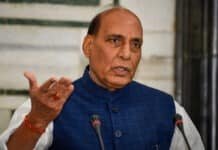

JAMMU — Defence Minister Rajnath Singh on Saturday said no power in the world could stop Jammu and Kashmir from becoming a developed state following the abrogation of Article 370, asserting that the Centre had made considerable progress in curbing terrorism and weakening separatist forces.
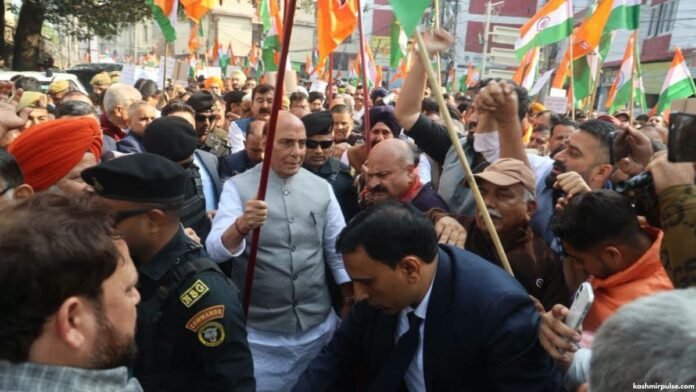
Addressing the BJP’s ‘Loktantra Bachao, Arajakta Hatao Sabha’ at Parade Ground in Jammu, Singh said the constitutional changes introduced in August 2019 had opened new avenues for development and enabled people in Jammu and Kashmir to access rights that, according to him, had previously remained unavailable.
“After the abrogation of Article 370, no power in the world can stop Jammu and Kashmir from becoming a developed state of India,” he said.
Describing Jammu and Kashmir as the crown of India, the Defence Minister said its complete integration with the country had always been a commitment of the BJP, rooted in the party’s efforts to safeguard national unity and territorial integrity.
He recalled the political struggle of Dr Syama Prasad Mookerjee and Pandit Prem Nath Dogra against the special constitutional status of Jammu and Kashmir, saying the BJP had fulfilled its long-standing commitment after securing a parliamentary majority.
“We did what we said. There is no difference between our words and actions,” Singh said.
He claimed that the Centre had succeeded to a large extent in curbing terrorism in Jammu and Kashmir and that separatist forces were gradually losing their influence.
“We had resolved to end terrorism, and I can say that to a large extent, we have succeeded in getting rid of terrorism from the soil of Jammu and Kashmir,” he said.
Recalling former Prime Minister Atal Bihari Vajpayee’s approach of ‘Insaniyat, Jamhooriyat and Kashmiriyat’, Singh urged people to look beyond the region’s troubled past and focus on its future.
Quoting the Kashmiri proverb, “Patim masrao, bron kun nazar thao”, he called for moving forward rather than remaining preoccupied with past difficulties.
Singh cites healthcare, tourism growth
Highlighting development initiatives under Prime Minister Narendra Modi, Singh referred to improvements in healthcare infrastructure and tourism as indicators of changing conditions in Jammu and Kashmir.
He cited the establishment of AIIMS, saying residents of the Union Territory no longer necessarily needed to travel to Delhi for treatment of serious medical conditions.
The Defence Minister also claimed that tourist arrivals had increased from 4.76 crore during an earlier three-year period to 7.85 crore between 2023 and 2025, benefiting traders, businesses and people associated with the tourism sector.
He said Jammu and Kashmir was witnessing new development milestones after years in which questions had been raised about its economic and infrastructure potential.
Referring to an account in the book Kashmir Under 370, written by a former Jammu and Kashmir Director General of Police and former CRPF chief, Singh cited an alleged incident involving the registration of land in which even the President of India had reportedly been treated as a non-state subject.
He said the account illustrated what he described as constitutional anomalies under the previous arrangement.
Attacks Congress, questions Rahul Gandhi’s allegations
Turning to national politics, Singh launched a sharp attack on the Congress and its allies, accusing them of attempting to destabilise a democratically elected government and undermine constitutional institutions.
He said the purpose of his visit to Jammu was not limited to addressing a public meeting but also to seek a collective commitment to protecting the Constitution, democracy and India’s unity and integrity.
Rejecting allegations of ‘vote theft’ levelled by the Congress, Singh said the BJP would not compromise democratic principles to remain in power.
“The BJP cannot steal votes, whether the government stays or goes. We do politics to build the nation, not merely to come to power,” he said.
Questioning the Congress’s claims of electoral malpractice, the Defence Minister challenged its leadership to produce evidence to support the allegations.
He said the Election Commission that oversaw the 2014 Lok Sabha elections had been constituted before the BJP came to power at the Centre, questioning attempts to attribute electoral irregularities to the present government.
“A country is governed by its Constitution, not by somebody’s feelings,” Singh said, criticising Congress leader Rahul Gandhi for making allegations that he said were not supported by evidence.
He also criticised the Congress for its electoral setbacks over the past 12 years, saying the party had repeatedly blamed electronic voting machines, election authorities and political opponents rather than examining the reasons for its defeats.
Referring to a Congress-organised summit in Hyderabad attended by Gandhi, Singh criticised remarks made by an Italian leader at the event, alleging that calls for removing an elected government were contrary to democratic principles.
He also accused Gandhi of making misleading statements on national security and undermining the morale of the armed forces.
Referring to Gandhi’s earlier remarks concerning Indian and Chinese soldiers, Singh invoked observations made by the Supreme Court and said political differences should not come at the cost of national interests.
“Opposing the government and opposing India are two different things,” he said.
Defends democratic mandate, criticises dynastic politics
Taking aim at dynastic politics, Singh said Prime Minister Narendra Modi had not inherited political power but had been entrusted with the responsibility of governing the country by voters.
“If anyone has made Narendra Modi the Prime Minister, it is the people of India. If anyone can take that responsibility away from him, it is only the people of India and nobody else,” he said.
“Modi is not going anywhere. It is time for the Congress to pack up,” he added.
Singh also criticised Gandhi’s remarks concerning Hindus and the Ram Temple ceremony in Ayodhya, saying people belonging to different religious communities were equal and should live together.
He questioned Gandhi’s participation in parliamentary proceedings, arguing that elected representatives should use Parliament to debate government policies and raise public issues.
The Defence Minister claimed that Gandhi’s attendance during previous parliamentary terms had remained below the national average for MPs and accused him of focusing more on opposing Modi than participating in legislative debates.
Singh said there was nothing wrong with aspiring to become Prime Minister, but treating political office as a birthright was contrary to democratic principles.
Recalls emergency, criticises Congress record
The Defence Minister also accused the Congress of having a history of undermining democratic and constitutional institutions, referring to the dismissal of elected state governments during Indira Gandhi’s tenure and the reversal of the Supreme Court’s judgment in the Shah Bano case.
He alleged that the Congress government had overturned the court’s decision concerning Muslim women’s rights for political considerations.
Rejecting comparisons between the Emergency and the present government’s actions, Singh recalled his own imprisonment during the Emergency imposed in 1975.
“I was barely 24 or 25 years old. I spent 18 months in jail and was also kept in solitary confinement for some time. My mother passed away while I was in jail, but the Congress government did not grant me parole,” he said.
He also recalled the government’s position before a court in 1976 that, according to his account, even the family of a person unlawfully killed by a police officer could not approach the judiciary for justice.
Singh cited restrictions imposed on the broadcasting of legendary singer Kishore Kumar’s songs after he reportedly declined to participate in a government programme during the Emergency.
He said these incidents reflected the suppression of civil liberties and freedom of expression during that period.
Earlier, Singh paid tributes to Pandit Prem Nath Dogra, Dr Syama Prasad Mookerjee and others who had sacrificed their lives for the unity and integrity of the country.
Describing Jammu as a land of courage, sacrifice and self-respect, he said the region held a special place in the BJP’s political journey.
J&K BJP president and Rajya Sabha MP Sat Sharma, Lok Sabha MP Jugal Kishore Sharma, Rajya Sabha MP Gulam Ali Khatana, former Deputy Chief Minister Dr Nirmal Singh, former J&K BJP president Ravinder Raina and other senior party leaders attended the gathering.
Follow Us
The Kashmir Pulse is now on Google News. Subscribe our Telegram channel and Follow our WhatsApp channel for timely news updates!