
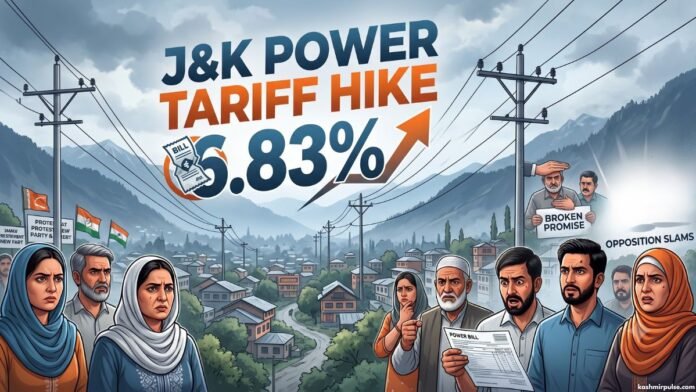
SRINAGAR — The Joint Electricity Regulatory Commission (JERC) for Jammu & Kashmir & Ladakh has approved a 6.83% average hike in power tariff for Jammu and Kashmir for 2026-27, effective September 1.
According to an order issued by JERC, bills issued for consumption from that date will be charged at the new rates.
The regulator said JPDCL and KPDCL had sought a tariff hike to bridge their revenue gap, having proposed a 5% across-the-board increase.
Revenue gap and government subsidy
As per the order, the total Annual Revenue Requirement (ARR) of both DISCOMs after prudence check is ₹10,275.72 crore, while revenue at the existing tariff is only ₹7,352.87 crore, leaving a gap of ₹2,922.85 crore.
“If this entire gap was to be met through tariff alone, the hike would have been around 40%, which would have resulted in a tariff shock to consumers,” the Commission said.
The Commission has factored in ₹2,420.78 crore of financial support committed by the J&K government as a subsidy under Section 65 of the Electricity Act, 2003. With the revised tariff, revenue will rise to ₹7,854.94 crore, and the remaining unmet gap of ₹2,420.78 crore will be met through government grant-in-aid.
Time-of-Day tariff introduced
JERC has also officially introduced Time-of-Day (ToD) tariff billing across Jammu and Kashmir for all categories except agricultural consumers with a sanctioned load of more than 10 kW.
Under the order, peak hours are set as 6 am to 9 am and 5 pm to 10 pm — a total of eight hours daily — while solar hours run from 9 am to 5 pm, also eight hours daily. Remaining hours will be treated as normal hours, billed at standard energy charges without surcharge or rebate.
“During peak hours, a 20 percent surcharge on energy charges will be applicable for industrial (LTIS, HT industry, HT PIU) and commercial (LT non-domestic consumers and general-purpose bulk supply). For all other consumer categories, a 10 percent surcharge during peak hours will be applicable. During solar hours, a 20 percent rebate on energy charges will be applicable for all categories,” JERC said.
The Commission noted that the Ministry of Power, Government of India, under the Electricity (Rights of Consumers) rules, had recommended that ToD tariff during peak hours be 20% and 10% higher than normal-period tariff for the respective categories. “The Commission decides that ToD tariff shall be applicable to all consumers, except agricultural consumers, having sanctioned load/contract demand above 10 kW, subject to availability of compatible metering and billing infrastructure,” the order stated.
KPDCL had proposed a 20% hike in ToD tariff during peak hours for all domestic and commercial consumers, excluding agriculture, in line with Ministry of Power regulations.
Trade body opposition
The Kashmir Trade Alliance (KTA) strongly opposed the tariff hike, terming it an additional burden on consumers, traders and businesses at a time when the J&K economy is already under strain.
KTA President Aijaz Shahdhar said the increase could weaken economic activity and hurt businesses already struggling with rising operational costs, subdued demand and declining purchasing power. “The economy of Jammu and Kashmir is already facing a downslump. At such a time, the priority of the government should be to provide an impetus to economic activity, support businesses and reduce the burden on people,” he said.
Shahdhar said the hike was difficult to justify given continued power curtailments and unreliable supply in several areas. “People were promised relief in electricity bills, including 200 units of free electricity, but instead they are now being asked to pay more. This is a contradictory approach,” he said.
He said traders, manufacturers, hotels, restaurants, workshops and other commercial establishments would be directly affected, and urged the government to reconsider the hike and take up the matter with JERC, while also calling for measures to reduce transmission and distribution losses and improve revenue collection.
Political reaction
The hike drew criticism from opposition leaders, a ruling party MP and the business community, who questioned the government’s unfulfilled promise of 200 units of free electricity to households.
Leader of Opposition Sunil Sharma of the BJP termed the hike a “betrayal,” saying the National Conference had come to power promising 200 free units per household. “The NC government promised 200 units of free electricity to every household. But instead of fulfilling that commitment, people are now facing an increase in electricity tariffs. This is not relief; it is a betrayal of the trust placed in the government,” Sharma said. He said the government must explain why its promises had not been fulfilled and that the BJP would continue to hold the NC-led government accountable.
Peoples Conference president Sajad Gani Lone called the hike a “shock” for consumers who had been promised free electricity in 2024. In a post on X, Lone said the regulator had approved the increase while claiming to have avoided a tariff shock, but for consumers who were promised free power, the increase itself was a shock. He said nearly two years after the Assembly elections, no benefit under the 200-unit free-power promise had been passed on to consumers, and alleged the government had also increased load in non-metered areas, pushing up bills.
National Conference MP Aga Ruhullah Mehdi said the same Chief Minister who had promised to “throw meters into the river” had instead raised the power tariff by nearly seven percent, contradicting commitments made ahead of the 2024 Assembly elections.
PDP MLA from Pulwama, Waheed Ur Rehman Parra, said the hike came at a time when “unemployment was at a peak, inflation was biting hard, and ordinary families were struggling to make ends meet.” In a post on X, Parra asked, “From free tariff promises of relief to higher bills, what happened to the promise?” and questioned Chief Minister Omar Abdullah over the NC’s electoral commitments of free electricity, free gas and free ration.
Apni Party president Altaf Bukhari also criticised the tariff hike, saying the move would further trouble the people of Jammu and Kashmir and questioning the government’s approach at a time when people were already facing economic pressure.
Follow Us
The Kashmir Pulse is now on Google News. Subscribe our Telegram channel and Follow our WhatsApp channel for timely news updates!