
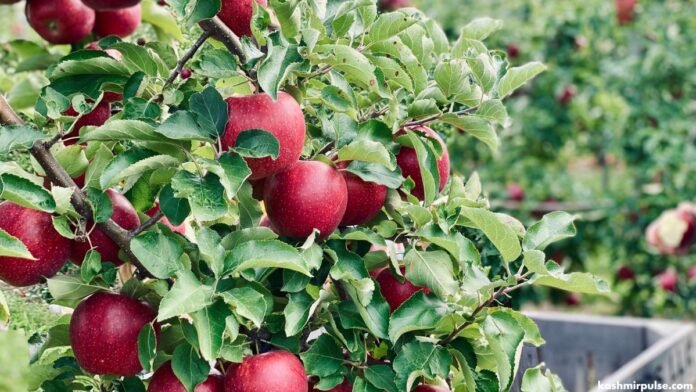
SRINAGAR — Apple growers across Kashmir are increasingly turning to high-density cultivation, replacing older orchards with modern varieties in pursuit of higher yields, improved returns and lower crop-management costs.
The shift is also changing land-use patterns in some areas, where growers are removing old apple and almond trees and converting land traditionally used for paddy cultivation into apple orchards.
High-density cultivation allows more plants to be grown in a smaller area and can bring orchards into commercial production sooner than conventional systems. Growers are showing increasing interest in imported varieties that offer the potential for higher productivity and more efficient use of available land.
The Jammu and Kashmir government introduced a scheme in 2016 to promote high-density apple cultivation by providing financial assistance to eligible farmers replacing old and less productive orchards. Under the scheme, growers can receive a 50% subsidy, subject to departmental assessment and prescribed conditions.
The Horticulture Department also provides technical guidance on site selection, plantation layout, irrigation and other aspects of orchard management.
An official from the department told the news agency KNO that the scheme was intended to help growers modernise their orchards and improve productivity.
“After assessing the site, its suitability and the availability of irrigation facilities, financial assistance is provided to eligible growers for establishing high-density plantations. The objective is to encourage scientific cultivation and help farmers obtain better returns from their land,” the official said.

The official said the estimated cost of establishing a high-density orchard on one kanal of land was around ₹1.60 lakh, of which the government provides ₹80,000 as a subsidy, while the beneficiary contributes the remaining amount.
The official added that high-density plantations require careful planning and regular maintenance, with irrigation being one of the most important components.
According to horticulture officials, traditional orchards generally accommodate around 250 trees per hectare, while high-density systems can accommodate approximately 4,000 plants per hectare, depending on the variety and planting system.
Showkat Ahmad, a high-density apple grower, said the system’s productivity improves as the trees mature, encouraging more farmers to adopt the method.
“The response from growers has been encouraging because high-density plantations offer the possibility of better production and improved returns. The yield increases as the orchard develops, and the quality and market value of the produce can also make a difference to a grower’s income,” he said.
Lower input costs and higher yields
Horticulture experts say high-density cultivation may also help reduce the use of agricultural inputs associated with some traditional orchards, where taller trees can make spraying and other management operations more difficult.
Ansar-ul-Haq, assistant manager at Master Pro Lassipora, said high-density apple plantations could reduce fertiliser consumption by around 70% and pesticide spraying by nearly 80% compared with conventional systems.

He said some high-density varieties could produce around 50 to 70 metric tonnes of apples per hectare by the third year under suitable conditions, while traditional orchards generally produce considerably lower quantities.
A scientist associated with the Sher-e-Kashmir University of Agricultural Sciences and Technology of Kashmir (SKUAST-K) said modernising the horticulture sector was important for improving the economic prospects of fruit growers.
The scientist said high-density cultivation offered an opportunity to increase productivity by making more efficient use of available land. Certain varieties also offered improved resistance to apple scab, potentially reducing crop losses and the need for chemical treatments.
Land-use changes raise questions
The growing popularity of high-density orchards has also brought changes in agricultural land use into focus, particularly in areas where paddy cultivation has traditionally been an important source of livelihood.
Experts have stressed that farmers should carefully assess land suitability, long-term water availability, establishment costs and market conditions before switching to high-density plantations.
They have also emphasised the importance of technical guidance and effective implementation of government support schemes to help growers make informed decisions about the transition.
Follow Us
The Kashmir Pulse is now on Google News. Subscribe our Telegram channel and Follow our WhatsApp channel for timely news updates!