

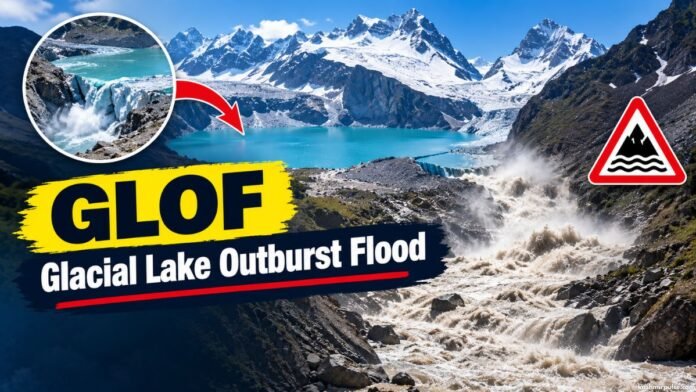
SRINAGAR — Five glacial lakes in the Kashmir Himalaya have been classified as having very high susceptibility to glacial lake outburst floods (GLOFs), with modelling indicating that a potential outburst could affect 2,704 downstream buildings and 15 major bridges, as well as roads and a hydropower project, according to a study published in the Journal of Glaciology.
The study assessed 155 glacial lakes using multiple indicators linked to GLOF susceptibility. Bramsar, Nundkol, Bhagsar, Chirsar and Gangabal were placed in the very-high-susceptibility category.
Another 35 lakes were classified as having high susceptibility, while 77 were placed in the moderate category.
The researchers found that the factors contributing to susceptibility varied among individual lakes. Bramsar recorded the highest susceptibility index, followed by Nundkol, Bhagsar, Chirsar and Gangabal.
The assessment estimated that potential outburst events from Bramsar and Chirsar could affect 406 buildings and five bridges.

Potential events involving Nundkol and Gangabal could affect 1,184 buildings, four bridges and a hydropower project, while Bhagsar could expose 1,114 buildings and six bridges, along with the Mughal Road.
Taken together, the five lakes were assessed as having potential downstream exposure involving 2,704 buildings and 15 major bridges.
The researchers cautioned that the exposure figures are indicative because the assessment relied on buffer-based modelling rather than a full physically based simulation of an actual flood.
They recommended continued satellite and field monitoring, hydrodynamic modelling and community-based early-warning systems to improve preparedness for potential GLOF events.
Follow Us
The Kashmir Pulse is now on Google News. Subscribe our Telegram channel and Follow our WhatsApp channel for timely news updates!