
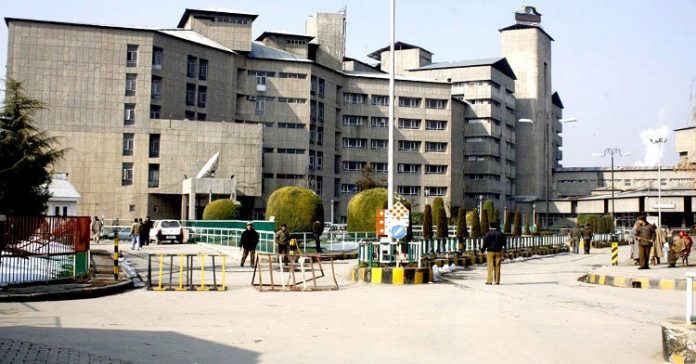
SRINAGAR — Over 80 percent of people who suffer accidental head injuries in Kashmir get medical intervention after the loss of “golden hour”, which lessens their chances of survival, a latest study by Sher-e-Kashmir Institute of Medical Sciences (SKIMS) has revealed.
The neurosurgery department of SKIMS has compiled the study regarding the head trauma, involving at least 1153 head injury cases, which reported at the Institute, between November 2017 and October 2018.
The study revealed that 80.70 percent of the total cases had reached the hospital after loss of the golden hour, the first hour after receiving trauma, which is considered to be very critical. “This depicts the poor pre-hospital management and slow transportation of these injured, potentially salvageable patients to the referral centers,” the researchers deduced.
Most of these injuries are caused in road accidents (50.3 percent) while falls from height was another cause of injury to another 28 percent, according to the study carried out by Dr Irfan Hussain.

Head department of neurosurgery at SKIMS, Prof Altaf U Ramzan, who co-guided the study along with Dr Nayil Khursheed, said that survival chances of people injured in road accidents decreases considerably with delay in reaching the hospital and with the “dangerous manner” in which people transport the injured.
“There is a protocol that needs to be followed while lifting and transporting an injured person,” he said adding that often the wrong manner of transporting and lifting injured individual results in worsening the injury outcomes.
While explaining he said that many people injured on roads have an unstable spine injury or a compromised airway, which if not addressed by a trained professional immediately, could lead to death or lifelong disability.
An efficient and fast ambulance service, he hoped, could help in saving lives. “Definitely, if a person, trained in basic life support is able to reach an injured person immediately, and provide intervention needed at that time, it could save a person’s life,” he said.

He added that in addition to improving patient transport services, there was a need to improve trauma care services in hospitals as well.
Recently, the state government, after years of failure to make 108 ambulance service operational, decided to outsource it. This fleet 120 ambulances announced in 2012 is meant to provide safe, round-the-clock and prompt transport of those injured in road accidents through a control room and GPS fitted vehicles.
However, for years, in a state where injuries are the leading cause of death and disability in the young (15-39 years), according to Indian Council of Medical Research data, no efforts have been made to reduce the time between injury and medical help. (GKNN)
Follow Us
The Kashmir Pulse is now on Google News. Subscribe our Telegram channel and Follow our WhatsApp channel for timely news updates!